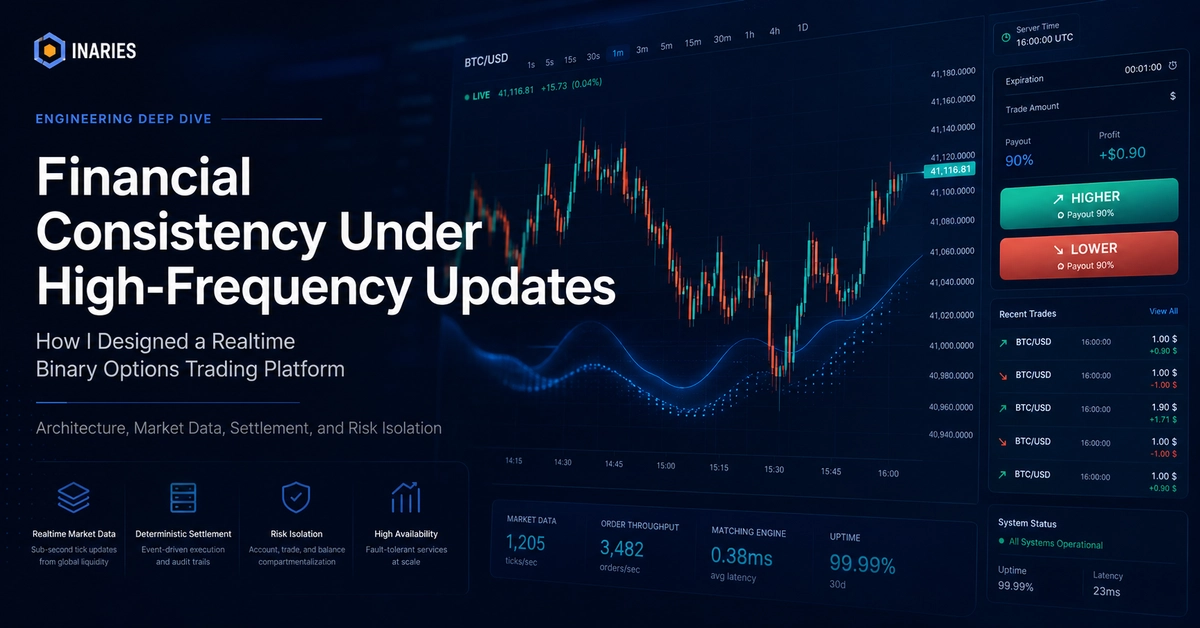
The blinking cursors, the rapidly updating candles – that’s what users see. That’s the part that looks like trading. But as one architect, who single-handedly built and deployed a production-ready real-time binary options platform from 2018 to 2024, discovered, this visual layer is the easy bit. The true engineering battle, the one that keeps systems honest and prevents financial chaos, is deciding where actual financial truth resides when everything is in constant flux. Prices shift by the nanosecond, user positions are ephemeral, browsers freeze, quote feeds can hiccup and go stale, and yet, user balances must remain immutable. That’s the core problem he tackled.
His project spanned a surprisingly broad technical landscape: a client trading terminal, a backend administrative SPA, strong real-time quote ingestion, precise order placement and automatic settlement logic, multiple trading modes (real, demo, tournament), payment and withdrawal workflows, KYC procedures, anti-fraud measures, referral systems, tournaments, and a sophisticated Redis-based broadcasting system, all parceled into Docker-separated runtime processes. This wasn’t just a frontend dashboard; it was a full-fledged financial ecosystem, engineered from the ground up.
Why the Chart Isn’t the Source of Truth
The public-facing trading terminal, with its slick charting, open positions, and historical views, was merely one facet. Beneath the surface lurked a sprawling operational platform. Think Vue for the front, Laravel for the APIs that handled everything from trading and user profiles to deposits, withdrawals, and admin functions. Then came the grunt work: a persistent quote parser tethered to a market data stream, an order checker that diligently closed expired positions, scheduled jobs for tick cleanup, payout recalculations, and a host of other maintenance tasks. Real-time communication was handled via Redis and Laravel Echo Server, pushing balance changes and order-close events directly to the browser through secure, private channels.
At its heart, the system use a Laravel monolith, but its deployment was far from a simple, undifferentiated blob. The key insight was to maintain a single, coherent domain model while intelligently splitting operational workloads into distinct processes. The web app, the parser, the settlement worker, the scheduler, and the WebSocket gateway each possessed unique lifecycles and failure modes, yet they were all bound by the same fundamental business rules.
The overarching design principle was elegantly simple, yet profoundly impactful: Keep the domain model centralized; separate the runtimes that stress it in different ways. This architecture kept the system’s core logic isolated and manageable, even as individual components faced distinct challenges.
The Authority of the Backend
The chart, as dynamic and responsive as it might be, was primarily for visualization. It offered a user a good sense of market movement, but it was never authoritative enough to actually settle money. Why? Because browsers lag. WebSocket messages can get lost or arrive out of order. Laptops sleep. Mobile connections drop. A chart might display a price that’s visually useful in the moment, but completely unsafe for critical financial calculations. The architect’s decisive separation of price handling into two distinct concerns was instrumental:
- Visualization data: This was the stream the frontend consumed to render candles, charts, and real-time price indicators. It was about user perception.
- Financial data: This was the bedrock. The backend quote parser meticulously maintained server-side ticks and the definitive market status, which the trading engine relied upon for all its decisions. This was about immutable financial reality.
Users could watch the market move on their screens, but it was always the backend that ultimately decided if a trade was even possible and, critically, how it would be resolved. The guiding rule, a mantra etched into the system’s design, was clear: The chart is a projection. The backend is the authority.
This single, unyielding rule was a bug-killing machine. It ensured that settlement didn’t depend on a user staying connected, the UI receiving the absolute latest packet, or a browser timer firing with perfect, unattainable precision. The system’s integrity was no longer tethered to the vagaries of the client-side environment.
Deconstructing the Operational Roles
The platform’s operational might was distributed across five primary roles, each with a distinct purpose and lifecycle:
- The web process was the front door for HTTP requests. It handled authentication, served the admin and trading SPAs, managed trading and profile APIs, processed deposits and withdrawals, and processed critical payment callbacks.
- The quote parser, a persistent sentinel, maintained a continuous WebSocket connection to the market data source. It subscribed to active symbols, meticulously parsed incoming quote packets, wrote those ticks to persistent storage, updated market status, and crucially, refreshed a heartbeat signal. This heartbeat acted as a vital ‘are you alive?’ indicator for the rest of the system, confirming that fresh quote data was still flowing.
- The order checker was the diligent accountant. It systematically scanned open positions that had expired, identified the precise server-side tick that occurred before expiration, calculated the win/loss/refund scenario, moved the resolved order into the historical record, updated user balances and accumulated statistics, and broadcasted the final closing events to relevant parties.
- The scheduler was the orchestrator of recurring tasks. Implemented within the Laravel scheduler, it managed minute-level jobs for tasks like tick cleanup, deposit processing, payout recalculation, exchange rate updates, and short-window statistics. Less frequent but equally important jobs included tournament status checks and GeoIP database updates.
- The realtime gateway, powered by Redis and Laravel Echo Server, was the pulse of the system. It was responsible for delivering critical business events – balance changes, order-close notifications, tournament updates, and symbol status changes – directly to the browser via authorized private channels, ensuring users received timely information without constant polling.
This architectural split wasn’t a mere organizational preference; it was a fundamental necessity. Quote ingestion requires a persistent, stable connection. HTTP requests are inherently short-lived. Settlement, however, is time-sensitive and demands absolute accuracy. Trying to shoehorn all these disparate requirements into a single, monolithic runtime would have been an engineering nightmare. By separating concerns, each component could be optimized for its specific workload, leading to a more stable, scalable, and ultimately, reliable platform. The market data feed is constant, the trading engine needs to be definitive, and the UI just needs to show what’s happening without becoming the ultimate arbiter of financial outcomes.
Why Does This Matter for Developers?
The challenge here isn’t unique to binary options. It’s a universal problem in any system that bridges the gap between a potentially unreliable client interface and a mission-critical backend. Think about financial trading platforms, real-time gaming, IoT data ingestion, or even complex collaborative editing tools. The core principle of separating presentation from authoritative data is paramount. Developers often face pressure to make the UI feel as real-time as possible, leading to the temptation of using client-side data for critical decisions. This case study is a stark reminder that such shortcuts lead to a brittle system, prone to bugs and financial discrepancies. The focus on server-side authority, even when it means slightly less instantaneous UI feedback, is the path to true engineering robustness. It’s about building systems that are correct, first and foremost.
Is This Architecture Overkill for Simple Apps?
For a simple blog or a static website, absolutely. The complexity described here—dedicated parsers, separate workers, sophisticated state management—is born from the extreme requirements of a real-time financial trading environment where even fractions of a cent and milliseconds matter. However, the core principle—maintaining a clear separation between how data is presented to a user and how it is validated and stored as the definitive truth—is applicable everywhere. For instance, in an e-commerce app, the price displayed on a product listing might be slightly out of date, but the price used during checkout must be the definitive, server-side price. The architecture for that checkout process needs to reflect that same data authority principle, even if it doesn’t require a dedicated quote parser.
The hard part is deciding where financial truth lives when prices change constantly, users open short-lived positions, browser tabs freeze, quote feeds can go stale, and balances still need to remain correct.
This isn’t just about building a trading platform; it’s about building trust in digital systems. When money is involved, or any critical state, the backend’s word must be final. The UI is a window, not the house. And in the world of real-time finance, a cracked window can be catastrophic.
🧬 Related Insights
- Read more: Mind Maps as Courses: A Year of Pathmind?
- Read more: Beyond Stripe: Building Inclusive Payment Systems [Case Study]
Frequently Asked Questions
What does a realtime binary options platform actually do? A real-time binary options platform allows users to speculate on whether an asset’s price will be above or below a certain point at a specific future time. Traders bet on a ‘yes’ or ‘no’ outcome, with a fixed payout if they are correct and a loss if they are wrong. The ‘real-time’ aspect means all data, from price feeds to trade execution, is updated and processed with minimal delay.
Will this architecture make my application faster? This specific architecture is optimized for the extreme requirements of financial data integrity and real-time accuracy, not necessarily raw speed in all contexts. Separating concerns can improve the performance of individual components (like the quote parser or the web server) by allowing them to focus on their tasks without interference. However, introducing more components can also add latency if not managed correctly. The primary goal here is reliability and correctness over absolute speed.
Is the quote parser the most critical component? The quote parser is exceptionally critical for the accuracy of the financial data. However, the backend’s determination of financial truth—which relies on the quote parser’s data but also includes the order checker and the core domain model—is the most critical element for the integrity of the system. Without a reliable data source (the parser), the backend can’t be authoritative. Without a strong backend processing logic, the data is useless.