Have you ever stopped to think about the digital infrastructure holding up your nation’s services? Because if you haven’t, you should. We’re not just talking about websites; we’re talking about the very gateways to public information, services, and, critically, your personal data. And a recent deep dive by SecurityBaseline.eu paints a rather alarming picture.
This isn’t just another dry report full of numbers and acronyms. This is a wake-up call, a blaring siren in the otherwise quiet corridors of government IT. SecurityBaseline.eu, an offshoot of the long-standing Dutch initiative Basisbeveiliging, has been meticulously scanning European government websites, and what they’ve found is… well, it’s a lot.
They’ve been flagging these issues, sending out tens of thousands of emails in advance, giving governments a chance to clean up their act before going public. Imagine that: proactive warnings, and still, the results are staggering.
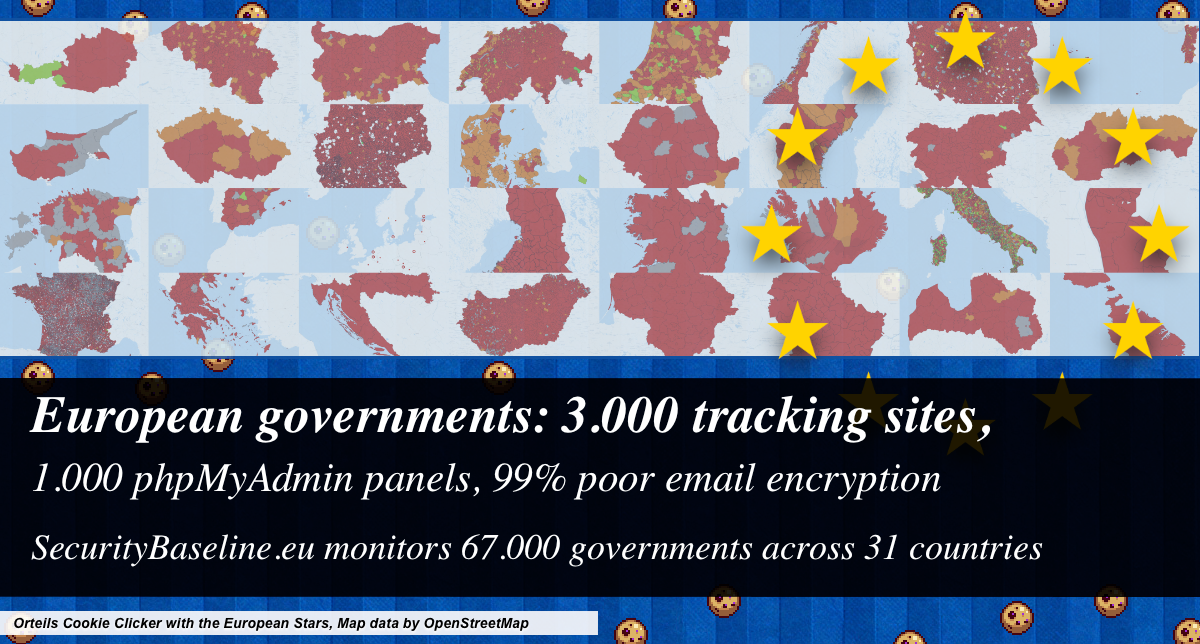
Let’s talk about the headline numbers, because they’re the ones that grab you by the lapels. We’re looking at 3,000 governmental sites plastered with tracking cookies that are likely — and I stress likely, given the legal nuances — violating privacy regulations. That’s your browsing habits, meticulously cataloged, probably for purposes far removed from citizen convenience.
Then there’s the chilling revelation of over 1,000 database management interfaces — think phpMyAdmin and its ilk — left dangling out in the open, accessible to anyone with a bit of curiosity and a rudimentary understanding of how the internet works. It’s like leaving the keys to the city hall’s filing cabinets on the front steps. This isn’t a hypothetical; this is the digital equivalent of a security breach waiting to happen, a gaping vulnerability in the very systems meant to protect us.
And the pièce de résistance? A staggering 99% of governmental email is poorly encrypted. Think about that. When your local government sends you information, an urgent notice, or handles sensitive data, it’s likely zipping across the internet in a form that’s easily intercepted. It’s as if they’re sending classified documents via postcard. It’s frankly astonishing.
This kind of transparency is precisely what’s needed. SecurityBaseline’s methodology, which they describe as “tried-and-tested publication, measurement, and code-of-conduct policy,” aims to make the digital landscape understandable. They’re not just pointing fingers; they’re providing the map, the data, and the visual tools—like their “Traffic Light Maps”—to make risks palpable.
The Architecture of Transparency
Their engine, Web Security Map, has been evolving for over a decade. The core belief is that you can’t fix what you can’t see. And seeing the internet’s underbelly, especially when it belongs to governments, can be a gritty experience. They map out EU member states, plus other European Economic Area countries, treating the EU itself as a single entity for data plotting. That’s 32 countries in total, broken down into administrative regions, which then get layered with 21 different security metrics. Every single night, these 1,827 maps get a fresh coat of paint based on the latest scans of over 200,000 internet domains.
It’s a monumental task, especially when you consider that the actual number of government domains is likely ten times higher. They’re finding “project” domains—think tourism boards, housing initiatives, festival sites—that often slip through official registries. This effort by SecurityBaseline.eu is akin to a digital archaeologist, unearthing buried structures of responsibility and vulnerability.
Why This Data Feels Like a Platform Shift
Look, we’ve talked about platform shifts before. The move from monolithic apps to microservices, from on-premise servers to the cloud. AI is the latest seismic shift, but this… this is a platform shift in governmental accountability. For too long, the opacity of public IT has been a shield. Now, with tools like SecurityBaseline’s, that shield is becoming a sieve.
This isn’t just about finding bugs; it’s about fundamentally changing the dynamic between citizens and their digital governance. It’s about demanding that the same rigor we expect in physical infrastructure – bridges, power grids – be applied to our digital one. And when 99% of email is poorly encrypted, it signals a systemic issue that transcends individual server configurations. It’s a cultural problem, a prioritization problem.
My unique insight here? This level of detailed, publicly accessible, and daily updated data on government security isn’t just a news item; it’s the blueprint for a new era of digital citizenship. It empowers not just security researchers but also the average citizen to ask, “What exactly are you doing with my data, and how safe is it?” This is the kind of granular transparency that forces real change, much like how early public health data transformed sanitation or how financial transparency regulations reshaped markets.
The domains we do measure are the most important ones for each government: their homepage and all subdomains below it.
It’s easy to get lost in the sheer scale of the problem. Denmark’s municipalities are mostly orange, meaning policies are in place but issues persist. Italy’s trick of using subdomains to push security issues higher up the chain is clever, but ultimately, it just shifts the problem, not solves it. The fact that a single issue—one tracker, one open database, one poorly encrypted email—can turn a map red speaks volumes about the absolute nature of security risk. There’s no such thing as ‘mostly secure.’
This is the future of digital governance: transparent, scrutinized, and, frankly, a little terrifying if you’re on the wrong side of the data.
The Road Ahead
SecurityBaseline.eu is asking for support, membership in the Internet Cleanup Foundation. It’s a plea born out of necessity. They’re monitoring over 80,000 organizations and 500,000 addresses. The scale of what needs to be done is immense. This isn’t just about national security; it’s about the sovereignty of our digital lives.
We’re at a tipping point. Will governments respond with the urgency this data demands, or will they continue to operate in the shadows of digital neglect? The answer, much like the security of our data, is uncomfortably uncertain.
🧬 Related Insights
- Read more: Submarine Comms: Still a Pain.
- Read more: 3.1 Seconds to Boil: The Precise Mind of George Goble Fades Out
Frequently Asked Questions
What does SecurityBaseline.eu do?
SecurityBaseline.eu monitors baseline security for European government websites, providing transparency through publicly accessible data and maps.
Why is 99% poorly encrypted email a problem?
Poorly encrypted email means sensitive information can be intercepted and read by unauthorized parties as it travels across the internet, posing a significant privacy and security risk.
How can citizens get involved?
Citizens can support the mission by becoming members of the Internet Cleanup Foundation or requesting research from SecurityBaseline.eu.