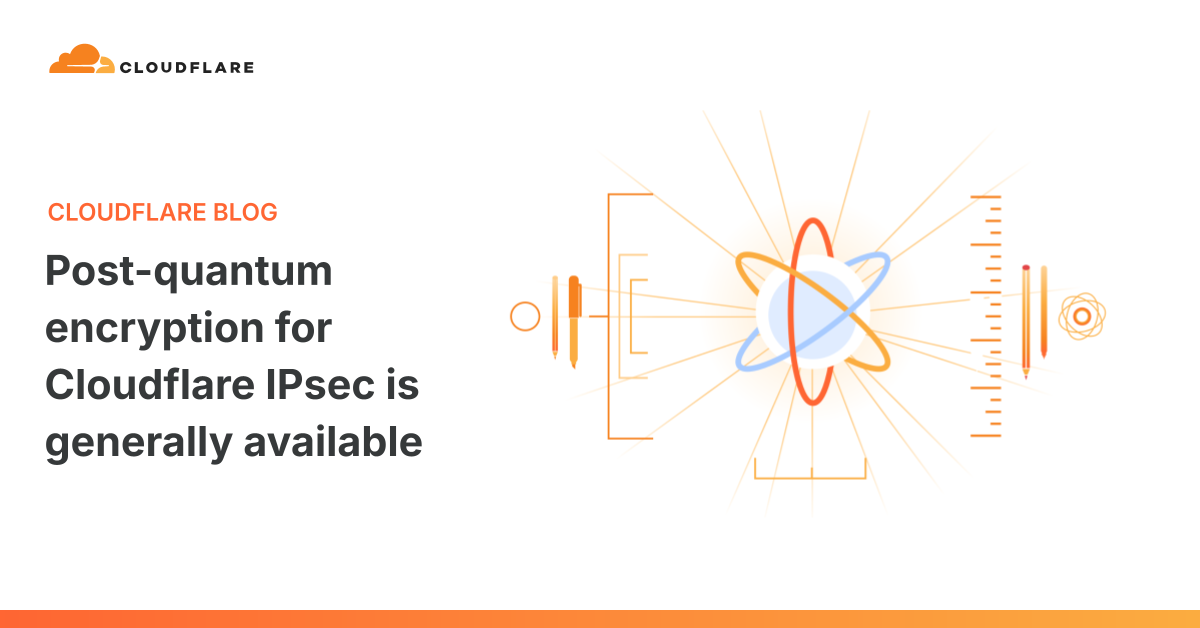
Are you still chugging along with yesterday’s encryption, blissfully unaware that quantum-powered decryption looms like a digital guillotine? Cloudflare would like you to stop doing that. Specifically, they’re now offering post-quantum encryption for their IPsec service, which is, you know, the stuff that connects your data centers and branches. It’s about time. While they’ve been dabbling in this for TLS traffic for a while now – apparently over two-thirds is already zapped with quantum-resistant keys – the site-to-site networking world has been a bit of a laggard. And that’s putting it mildly.
The Quantum Threat and the IPsec Lag
Look, the gist here is simple: quantum computers, when they get here (and Cloudflare’s moving their own target for full readiness up to 2029, so that should tell you something), will chew through most of the public-key cryptography we rely on today. The big fear is the “harvest-now-decrypt-later” attack. Adversaries are hoovering up encrypted data right now, sitting on it, waiting for Q-Day, when they can decrypt it all. It’s like an eavesdropper meticulously collecting every piece of mail you’ve ever sent, just waiting for the day they get a universal key to unlock your entire history.
For years, IPsec has been stuck in this weird no-man’s-land. It needed to be secure enough for specialized hardware but also scalable enough to work across the vast, messy internet. This new implementation, using a draft IETF standard called hybrid ML-KEM (FIPS 203), claims to bridge that gap. They’ve tested it with some big names like Fortinet and Cisco. So, theoretically, you can plug this into your existing gear and be a bit more quantum-proof, starting today.
Cloudflare’s WAN-as-a-Service Pitch
First, a quick primer on what Cloudflare IPsec actually is, for those who haven’t been neck-deep in corporate network architecture diagrams. It’s essentially Cloudflare’s way of saying, “Hey, instead of building your own complex WAN, just connect everything – your data centers, your branches, your cloud VPCs – to our massive global network.” The promise is simpler configuration, automatic failover if one of their data centers decides to take an unscheduled nap, and the sheer scale of their Anycast network. It all runs over encrypted IPsec tunnels, for everything from site-to-site connections to your outbound internet traffic and tying into their SASE platform.
The New Encryption in Town
So, what’s the magic sauce? Post-quantum encryption using this hybrid ML-KEM. It’s designed to thwart those harvest-now-decrypt-later attacks. ML-KEM, itself, is based on math problems that even quantum computers aren’t supposed to crack easily. Crucially, it’s meant to run in software on standard processors, no exotic hardware needed. The “hybrid” part is key here. The draft standard combines the familiar, albeit quantum-vulnerable, Diffie-Hellman exchange with the new ML-KEM. The idea is that the classical exchange runs first, and its output is used to encrypt the ML-KEM exchange, and then the results of both are mashed together to create the session keys for the actual data traffic.
Interoperability: The Real Win?
Cloudflare says they’ve moved this hybrid ML-KEM handshake into their production IPsec offering and confirmed it works with Cisco and Fortinet. This interoperability is apparently a “big win for this new standard.” It’s easy to see why. Upgrading cryptography across an enterprise is a nightmare that can drag on for years. The fact that this is based on an IETF draft (draft-ietf-ipsecme-ikev2-mlkem), which only landed late last year (seriously, four years behind TLS), means the industry is finally starting to coalesce around something that might actually work at scale.
But here’s the cynical veteran’s take: the fact that it took four years longer than TLS for a comparable standard to emerge for IPsec tells you everything you need to know about the inertia in the networking hardware world. TLS is relatively easier to update; you’re mostly dealing with software. IPsec often involves firmware on specialized boxes, which are slower to iterate. And while Cloudflare is pushing its 2029 target, that’s still a long way off for full quantum readiness across the board.
Given that upgrading cryptography is hard and can take years, our 2029 target date for a full update to post-quantum cryptography is going to require concentrated effort.
They say they hope the IPsec community keeps working on interoperable standards. Well, that’s a noble sentiment. But the real question is who’s actually writing the checks to make these upgrades happen across diverse, legacy-laden networks. Cloudflare is selling a service, and they’re making it easier for their customers to connect securely. The burden of upgrading the other end of the tunnel? That’s still on the customer, often with significant hardware refresh cycles involved. So, while this is a step, it’s a step that highlights just how much further the industry has to go.
Why Does This Matter for Developers?
For developers, especially those working on cloud infrastructure, network services, or even applications that handle sensitive data, understanding the cryptographic landscape is increasingly important. This isn’t just about encrypting your website’s login page anymore. Post-quantum cryptography is about future-proofing your entire stack. When your company’s network traffic is encrypted using these new standards, it means the data you’re transmitting is inherently more secure against future threats. It signals a shift towards a more resilient internet, where the underlying security protocols are designed with tomorrow’s adversaries in mind, not just today’s.
For developers building applications that interact with these networks, it’s about being aware of the protocols and libraries being used. Are your APIs communicating over tunnels that are quantum-ready? Are the services you depend on making the transition? It’s an ongoing evolution, and staying informed helps you build more strong and secure applications. The good news is that standards like ML-KEM, when implemented in software, can eventually become more accessible, allowing developers to integrate stronger security without massive hardware overhauls. But that transition takes time and, crucially, industry-wide adoption.
What About the Money?
Let’s be blunt. Cloudflare makes money by providing network services. Offering advanced security features like post-quantum IPsec is a selling point. It attracts customers who are concerned about future-proofing their infrastructure and are willing to pay for that peace of mind, especially large enterprises with long-term data security concerns. Vendors like Cisco and Fortinet stand to make money by selling new hardware or firmware updates that support these newer protocols, ensuring their customers remain “secure” and thus loyal. The developers working on the standards themselves? They’re often funded by research institutions, government grants, or the very companies that will eventually implement them. It’s a complex ecosystem where security advances are intrinsically tied to market demand and competitive advantage.
🧬 Related Insights
- Read more: Static Travel Apps No More: Bedrock’s Gen AI Turns Guides into Living Itineraries
- Read more: GitHub’s March 2026 Outages: Four Failures Reveal Cracks in Microsoft’s Code Empire
Frequently Asked Questions
Will this protect me from current quantum attacks? No, this is for protection against future quantum computers. Current quantum computers are not powerful enough to break the cryptography used in this standard, but the data being transmitted now could be harvested for later decryption once quantum computers are sufficiently advanced.
Do I need new hardware to use this? Cloudflare states that ML-KEM is designed to be implemented in software on standard processors, and they’ve confirmed interoperability with specific versions of Cisco and Fortinet hardware. However, always check your specific vendor’s compatibility list.
Is post-quantum encryption difficult to implement? The underlying mathematics can be complex, but the goal of standards like ML-KEM is to allow for software implementations on common hardware, making it more accessible than if it required specialized, expensive equipment. The challenge often lies in the broader ecosystem adoption and integration.