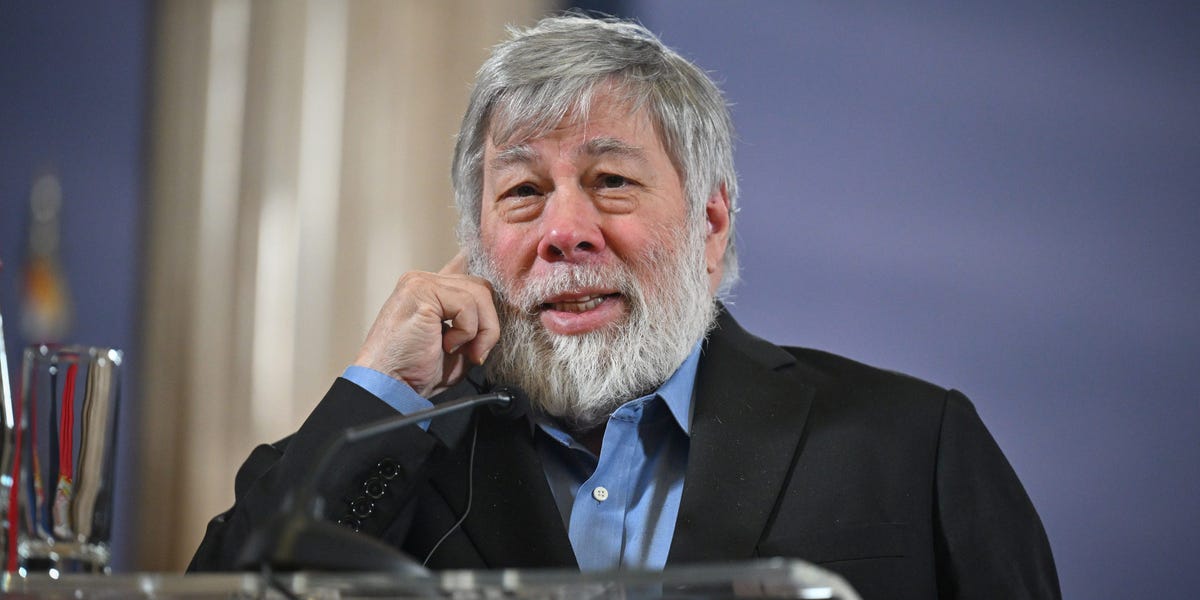
For the graduating class of Grand Valley State University, this year’s commencement speaker didn’t just drone on about the future; he offered a bracing, almost defiant, take on artificial intelligence that actually resonated. Steve Wozniak, the legendary Apple co-founder, managed to elicit cheers and laughter by telling students they possess something artificial intelligence can only mimic: actual intelligence. It’s a stark contrast to the reception some other tech titans faced recently, highlighting a growing unease—and perhaps, a subtle shift in perspective—among graduates as AI saturates the job market. Eric Schmidt and Gloria Caulfield, take notes.
This isn’t just feel-good commencement platitudes. The data is stark: AI is reshaping industries faster than anticipated. Automation is no longer a theoretical threat; it’s a driving force behind corporate restructuring and, yes, layoffs. Graduates entering the workforce are doing so under the shadow of algorithms capable of performing tasks once thought uniquely human. The question isn’t if AI will change their careers, but how drastically and how quickly.
Wozniak’s core message, distilled, is that human ingenuity—that spark of independent, creative thought—remains the ultimate competitive advantage. He framed AI as an ongoing attempt to “duplicate a routine a trillion times” to simulate a brain, implicitly drawing a line between computational power and genuine cognition. It’s a notion that, while perhaps simplistic, cuts through the AI hype and speaks to a fundamental truth: our capacity for original thought and problem-solving is our most potent tool.
Why Did Wozniak’s AI Take Land Differently?
The narrative around AI at graduation ceremonies has been fraught. For many speakers, the messaging has veered into either uncritical techno-optimism or dire warnings about job displacement. The former can sound tone-deaf to students already facing intense competition, while the latter can be paralyzing. Wozniak, by focusing on the inherent value of human intelligence, sidestepped these traps. He offered not a solution to the AI problem, but a reminder of the inherent strength the graduates already possess. It’s a subtle but critical distinction.
“You have AI – actual intelligence.”
This simple remark, delivered at the right moment, landed because it speaks to a perceived gap between what AI can do and what humans are. While AI excels at pattern recognition and task execution at scale, it currently lacks the capacity for genuine creativity, ethical reasoning, and nuanced human connection. These are the very skills Wozniak implicitly champions when he advises students to “think different.” It’s a call to arms for innovation, a reminder that simply replicating existing patterns won’t cut it when the world is rapidly automating them.
The ‘Think Different’ Mandate in an Automated World
Wozniak’s advice to “always try to think different” isn’t just a callback to Apple’s iconic slogan; it’s a strategic imperative for career longevity. In a landscape where AI can handle routine tasks with unparalleled efficiency, the premium will increasingly be on human originality. This means not just learning new technical skills, but cultivating a mindset that questions assumptions, explores unconventional solutions, and bridges gaps that AI—for all its power—cannot.
The market dynamics are already shifting. Companies are seeking individuals who can work with AI, directing its capabilities and leveraging its outputs, rather than those who compete directly with it on its own terms. The graduates of 2024 and beyond need to understand that their value lies not in their ability to process information faster than a machine, but in their capacity to interpret, innovate, and lead.
Wozniak’s remarks, while brief, offer a powerful counter-narrative to the prevailing anxiety surrounding AI. He’s not dismissing AI’s impact, but repositioning the human element as the indispensable variable. It’s a message of empowerment, urging new professionals to lean into their uniquely human cognitive abilities as they navigate an increasingly intelligent, but not necessarily wise, technological future.
What this ultimately means for real people—the graduates—is that the future isn’t a zero-sum game against machines. It’s an opportunity to redefine value by emphasizing what makes us distinctly human. The applause Wozniak received wasn’t just for a clever turn of phrase; it was for a reminder of their own intrinsic worth.
🧬 Related Insights
- Read more: Mind Maps as Courses: A Year of Pathmind?
- Read more: NestJS i18n Goes Vietnamese: Beyond English/Spanish [DevTools Feed]
Frequently Asked Questions
What does ‘actual intelligence’ mean in Steve Wozniak’s speech?
In Wozniak’s context, ‘actual intelligence’ refers to the inherent human capacity for creativity, critical thinking, ethical reasoning, and original problem-solving, as opposed to the pattern-matching and task execution capabilities of artificial intelligence.
Why were other speakers booed for talking about AI?
Other AI-focused commencement speakers may have been met with negative reactions due to perceived tone-deafness, excessive techno-optimism that ignored job market anxieties, or a failure to offer relatable or empowering messages to graduates facing an AI-driven future.
How can graduates differentiate themselves from AI?
Graduates can differentiate themselves by focusing on skills that AI currently cannot replicate, such as complex problem-solving, creative innovation, emotional intelligence, leadership, ethical decision-making, and building human connections.