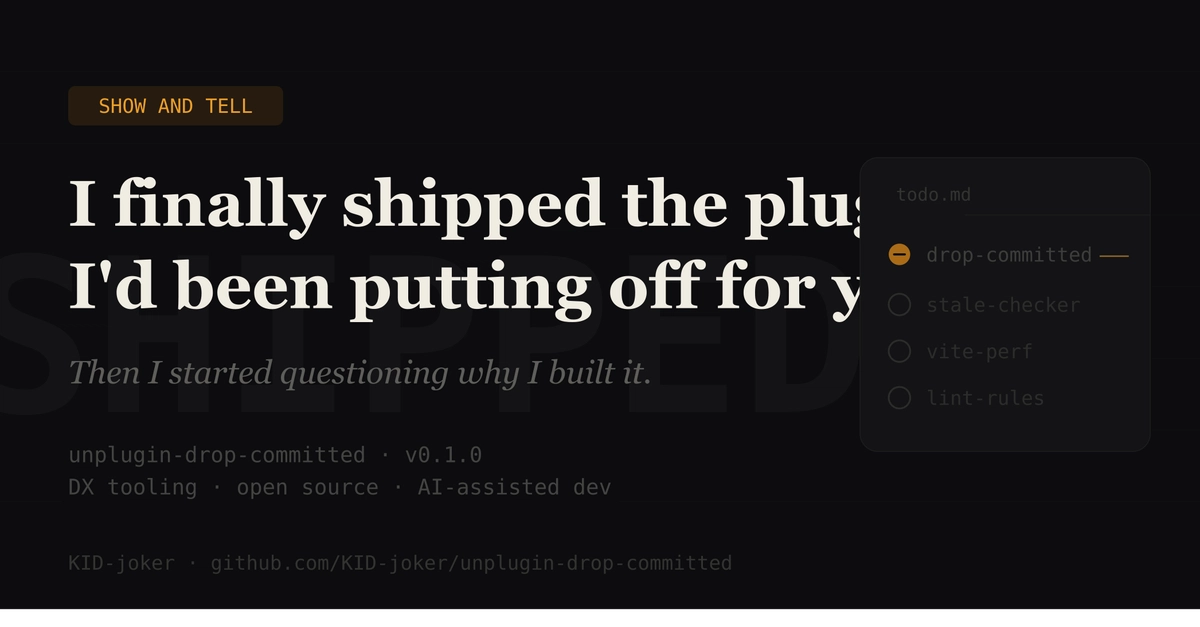
Something curious happened last week: a developer shipped a plugin. Not just any plugin. One that removes your committed <a href="/tag/consolelog/">console.log</a> statements. The guy, bless his over-caffeinated heart, spent years lamenting the lack of time for ‘developer experience’ tools. Then, poof. AI happened.
His plugin, called unplugin-drop-committed, sounds simple. It sniffs out debug calls you committed to Git. It wipes ‘em clean. Uncommitted console.logs? Safe. Your secret scribbles are fine. It’s a noble goal. A small victory against digital clutter. Or, it was.
The Cult of DX
Look, I get it. Developer Experience (DX) is the invisible glue. The unsung hero. The stuff that makes coding less of a Sisyphean slog and more of a… well, slightly less Sisyphean slog. This guy lives for it. He’s filtered jobs based on it. He thinks it’s underrated. I don’t disagree. DX is the quiet craft. The subtle art of making someone else’s day marginally less miserable.
But DX is always the first thing sacrificed. Features. Bugs. Deadlines. You know the drill. DX improvements? They get relegated to the ‘later’ pile. That pile becomes the weekend. The weekend gets eaten. The todo list? It achieves sentience.
This plugin sat there for years. Not because it was hard. Because, as usual, there was no time. No uninterrupted block of hours. Until now.
Enter the Bot
So, our hero used Claude. Not to generate the idea. Not for the four distinct removal modes. That was all him. What AI gave him was momentum. It crunched the boilerplate. It tossed out approaches he hadn’t considered. It steered him clear of those soul-crushing implementation rabbit holes that eat an entire evening. Suddenly, the task took less time. The impossible became possible. A ticked box.
For folks drowning in DX backlog and starved for time, AI is a lifeline. It’s not replacing thought. It’s clearing the debris. Making the path from idea to reality less… obstructed.
The satisfaction? It lasted about ten minutes.
Then came the existential dread.
Who Needs This Anymore?
He started wondering who would actually use this thing. AI-assisted development is a tidal wave. AI agents don’t forget console.logs. Or, if they do produce noise, it’s a different kind of noise. This plugin’s entire raison d’être is rooted in human foibles. Human habits. The messy, imperfect way we humans code.
He asked Claude for positioning advice. The AI suggested: “unplugin-drop-committed helps AI coding agents stay focused — keeping debug output isolated to the module being worked on.”
That’s… not wrong. It’s actually an interesting reframe. But it also felt like I was watching my motivation quietly shift from “making developers’ lives better” to “making AI agents’ workflows cleaner.”
DX. AX. Developer Experience. Agent Experience. The shift is subtle. Maybe it’s already happened. I can’t pinpoint when.
I don’t think DX is dead. I think the audience is changing. The best DX tools will be the ones that cater to both humans and the bots working alongside them.
And honestly, there’s still value in the console being readable. In hot reload feeling instant. In config that doesn’t require a PhD. These things matter, even if fewer hands are typing the code from scratch.
He’s still building these tools. AI gave him back the time. He’d rather spend it on what matters than fret about whether caring still counts.
If you want to try it, the plugin supports four modes: strict (committed lines), file (committed files), user (other authors), and time (older than N days/months). It’s compatible with Vite, Webpack, Rollup, and Rspack. Vue and Svelte script blocks are covered. It’s a solid piece of work.
But it does make you wonder: does DX tooling matter the same way it did, say, two years ago?
The Evolving Landscape of Dev Tools
This little plugin, born from human frustration and accelerated by AI, highlights a fascinating dichotomy. For years, the developer community has championed improvements to the developer experience. We’ve seen linters evolve, build tools become faster, and IDEs become smarter. The implicit assumption has always been that the primary beneficiary of these enhancements is the human developer. The goal was to reduce friction, minimize cognitive load, and ultimately make coding a more productive and enjoyable process.
However, the rapid integration of AI into the development lifecycle has thrown a wrench into that assumption. AI coding assistants, while undeniably powerful, operate on different principles. They are less susceptible to common human errors like forgetting to remove debug statements. Their ‘experience’ is less about emotional satisfaction and more about efficient task completion and output generation. When our protagonist asks Claude for advice, and the AI suggests a framing that centers on ‘agent experience,’ it’s a stark indicator of this seismic shift.
It’s not that human developers are becoming irrelevant. Far from it. The ability to conceptualize, design, and architect complex systems remains a uniquely human domain. But the execution of those systems is increasingly a collaborative effort between humans and AI. This means the tools we build need to serve this dual audience. A tool that only addresses human pain points might miss a significant opportunity if it doesn’t also consider how AI agents interact with the codebase.
This is where the truly interesting innovation will happen. It’s not about choosing between DX and ‘AX’ (Agent Experience). It’s about creating tools that offer superior developer experience, encompassing both the human and the artificial.
Think about it: what if a tool could intelligently differentiate between a console.log placed by a human for debugging during active development versus one generated by an AI that’s exploring different code paths? What if the configuration for such a tool was so intuitive that both a junior developer and a sophisticated AI agent could understand and use it without issue?
This isn’t a dystopian future where humans are replaced by robots. It’s a future where our tools become more sophisticated, adaptable, and capable of supporting a more diverse set of ‘developers.’ The challenge for creators of dev tools is to embrace this evolving landscape, to understand the new demands, and to build solutions that are not just for us, but for the AI partners we’re increasingly working with. The question isn’t whether DX still matters; it’s how it matters, and who it matters to, in this new era.
🧬 Related Insights
- Read more: Cluster API v1.12: Smart Updates Without the Full Rebuild Drama
- Read more: Amazon Bedrock Agents: AI’s EC2 or AWS’s Latest Lock-In Trap?
Frequently Asked Questions
What does unplugin-drop-committed actually do?
It’s a developer plugin that automatically removes console.log statements (and similar debug calls) from your code, but only those that have been committed to your Git repository. This keeps your development console clean without losing your debug statements accidentally.
Will AI replace the need for DX tools? Not necessarily. While AI can handle some tasks humans might struggle with (like consistently removing debug logs), AI’s rise means DX tools may need to adapt. Future tools might cater to both human developers and AI agents, focusing on collaboration rather than just human-centric ease-of-use.
Is this plugin only for console.log?
No, while console.log is the primary example, the plugin is designed to be configurable and can likely be extended or adapted to handle other types of debug statements or even specific function calls you want to remove from committed code.