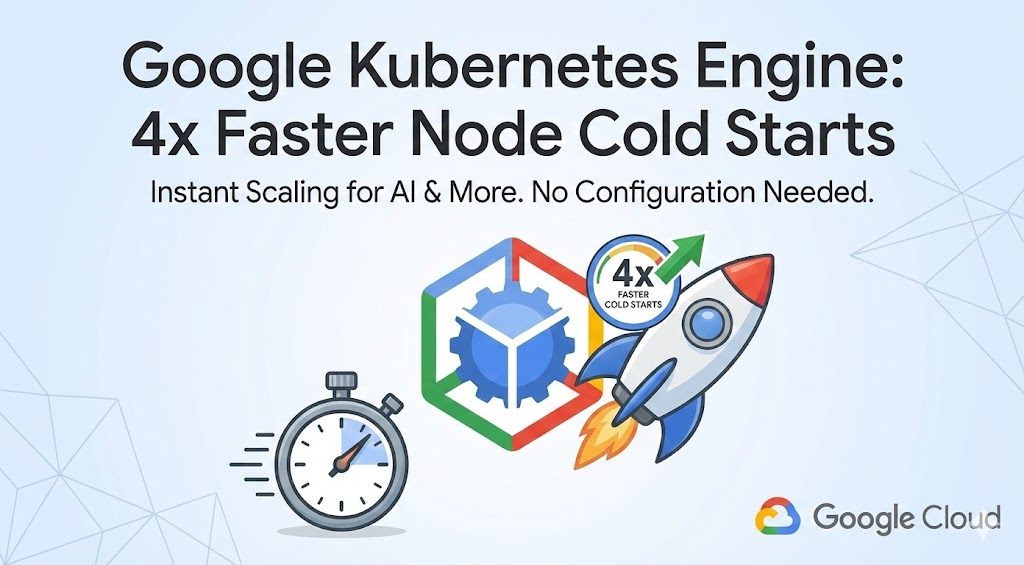
For years, the specter of the “cold start” has haunted cloud infrastructure. It’s that agonizing pause when demand spikes, and your autoscaler scrambles to spin up a new node, leaving users (or your models) in the lurch. The common workaround? Over-provisioning. You pay for idle compute, often for expensive accelerators, just to avoid the startup lag. It’s a tax on agility, a penalty for fluctuating demand. Now, Google Kubernetes Engine (GKE) claims to have largely exorcised this demon with an update promising up to four times faster node startup times.
This isn’t a mere config flag or a patch you need to apply. Google is framing this as a foundational architectural upgrade to how infrastructure is provisioned. The implication? Your nodes just start faster, right out of the box. The beneficiaries, they say, are those wrestling with dynamic scaling, especially for AI inference and rapidly deployed workloads. It’s about reclaiming wasted cycles and dollars.
The Pain of the Pause
The problem is deceptively simple, yet maddeningly pervasive. Imagine an AI model that’s typically idle, then suddenly inundated with requests. The autoscaler kicks in, requesting a new node. And then… you wait. This delay, this “cold start tax,” can be crippling. It’s not just an inconvenience; it translates directly into missed opportunities, degraded user experiences, and, for companies running scarce GPU-accelerated workloads, significant financial inefficiency. To sidestep this, many teams have resorted to keeping expensive compute instances humming idly, a costly insurance policy against the unpredictable nature of demand.
Reworking the Foundation
Google’s approach appears to be a significant departure from incremental tweaks. They’ve essentially rebuilt the provisioning logic for VMs and GKE nodes from the ground up. While the precise technical minutiae are understandably complex, the core strategy involves a trifecta: intelligent compute buffers, specially crafted fast-starting virtual machines, and a revised control plane architecture designed for near-instantaneous VM resizing without the need for reboots. The upshot is a GKE cluster that scales with inherent speed and efficiency, freeing up resources to be deployed where they’re genuinely needed.
Why Does This Matter for Developers?
For developers, this translates into a tangible reduction in operational overhead and an increase in application responsiveness. Less over-provisioning means trusting your autoscaler to react dynamically, rather than maintaining costly static buffers. For AI/ML teams, particularly those serving models via GPU-accelerated inference, the reduced time between a spike in demand and the model actually serving traffic is a game-changer. Crucially, the company emphasizes that this is an “out-of-the-box” improvement, requiring no manual configuration changes to existing infrastructure-as-code deployments.
This isn’t a setting you have to toggle or a config file you need to patch. It’s an architectural upgrade to how we provision infrastructure, meaning your nodes just start faster, out of the box.
This claim of “no Ops overhead” is a significant selling point. In the complex world of Kubernetes, any reduction in manual configuration is a win. The ability to benefit from faster node startups without altering Terraform or YAML files streamlines deployment and maintenance.
Availability and Access
The accelerated provisioning is currently live and available for workloads running on GKE Autopilot, including those within Standard clusters. The initial rollout supports specific hardware configurations, with Google promising further expansion to additional machine types in the near future. For those already leveraging GKE Autopilot with supported instance types, the performance improvement should be readily apparent. For users of GKE Standard clusters, the option to utilize Autopilot specifically for these high-demand, speed-sensitive workloads is now available without requiring a full cluster migration. This is achieved by directing Pods to the Autopilot ComputeClass, allowing them to inherit the accelerated startup speeds while coexisting with standard nodes.
The technical documentation for these fast-starting nodes offers a deeper dive for those who want to understand the underlying engineering. It’s a proof to the ongoing efforts within cloud providers to chip away at the inherent inefficiencies of distributed systems.
What’s Next on the Horizon?
Google’s announcement is more than just a feature release; it’s a signal of a deeper architectural evolution in cloud provisioning. The continued emphasis on reducing latency and optimizing costs for dynamic workloads suggests that further innovations in intelligent resource allocation and rapid provisioning are on the horizon. Companies that can effectively use these advancements will undoubtedly gain a competitive edge in agility and efficiency. The question now is how quickly other cloud providers will match this pace, and whether this marks the beginning of the end for the costly “cold start” penalty.