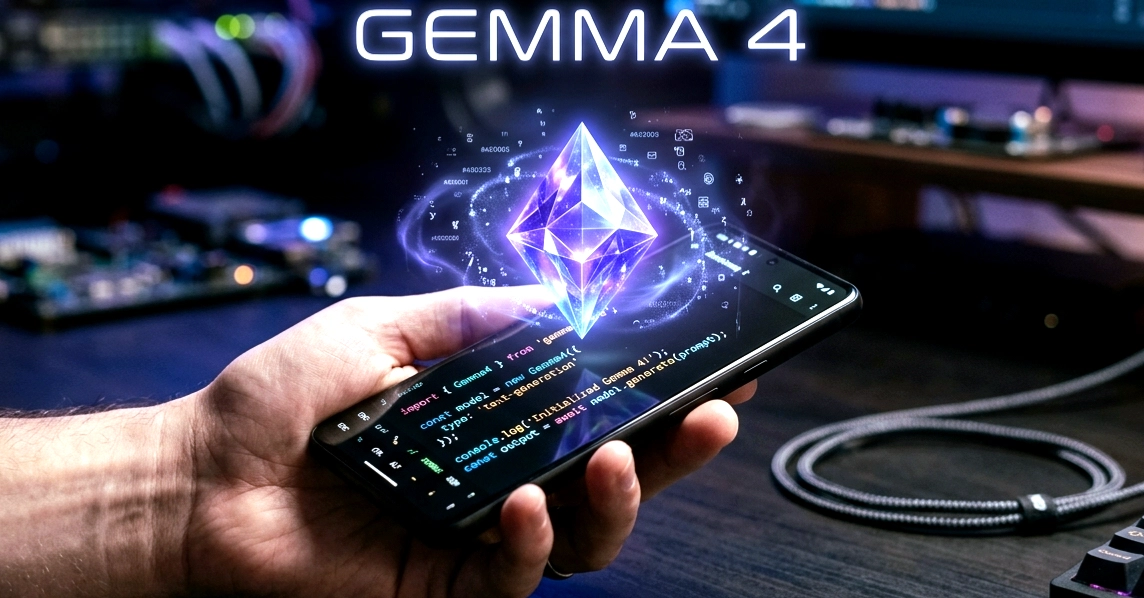
Everyone was expecting the AI revolution to be loud, demanding, and expensive. Think sprawling server farms, colossal GPU clusters, and a price tag that would make your accountant weep. That’s the narrative we’ve been fed for years: AI is big, AI is hungry, and AI needs a serious beefy rig to even breathe. But then, poof. Out of nowhere, this little thing called Gemma 4 drops, specifically its E2B model, and suddenly the script is getting rewritten. The promise? AI that fits in your hand. Like I said, the game allegedly changed.
Look, I’ve been covering Silicon Valley long enough to smell the exhaust fumes of a hyped product from a mile away. The buzz around Gemma 4, particularly the E2B (2.3B parameter) model, is palpable. The story goes that this is the bridge for students and developers stuck in the mobile-first world, finally letting them play in the AI sandbox without needing a portable supercomputer. The narrative is simple: the ‘AI gap’ is closing because this little model can run right there, on your phone, on ‘the edge’. Sounds neat, right? But who’s actually making money off this, and what’s the real cost of this ‘convenience’?
Is ‘The Edge’ Just Another Buzzword?
We’re told the E2B model is designed to run on ‘the edge’. For a mobile developer, this is supposedly the device in your hand. This isn’t exactly a new concept; edge computing has been a thing for a while. What’s different here, the pitch insists, is the AI part. Running complex models, especially those with vision and audio, typically demanded gobs of memory. The magic ingredient? Quantization. Apparently, Gemma 4’s E2B can cram a significant ‘brain’ into a footprint small enough for a mobile device. To put it bluntly, they’re claiming to shave off the massive RAM requirements. Where standard models might scoff at anything less than 8GB to 16GB of VRAM, Gemma 4 E2B, when optimized, supposedly sips around 1.5GB of RAM. For students toiling away in Termux or Acode, this is painted as the ultimate democratizer, turning spectators into ‘architects.’ Architects of what, exactly? That’s the million-dollar question.
Speaking Your (JSON) Language? Maybe.
What’s particularly interesting, and less overtly snake-oil-ish, is the claim that Gemma 4 ‘speaks our language.’ The author, a student coder, found integrating it with Node.js to be surprisingly straightforward. Why? Because it’s optimized for structured JSON output. This means it plugs into a Node.js backend almost like calling any other API. This detail, if true and consistently reliable, is actually compelling. Integrating AI models into existing workflows without a colossal refactoring effort is the holy grail for many dev teams. It sidesteps the need for massive infrastructure shifts and lets developers focus on building features, not fighting with boilerplate.
Gemma 4 has taught me that the wait is over. By focusing on efficiency and local-first capabilities, the ‘AI gap’ has officially closed for students like me. We are no longer just spectators; we are architects of the future, even if that future is built from a device that fits in our hands.
This quote, while enthusiastic, sums up the prevailing sentiment the author wants to convey. It’s the classic ‘democratization of AI’ narrative. But let’s not get too misty-eyed. My skepticism kicks in when this democratizing spirit is so tightly bundled with a specific product. The ‘AI gap’ closing for students is a noble goal, but is Gemma 4 the only or even the best way to achieve it? Or is it just the first player to market with a digestible story for a specific segment?
The Real Cost of ‘Convenience’
For twenty years, I’ve watched every new tech wave. The promise of doing ‘real work’ on a device that fits in your pocket is seductive. We heard it with PDAs, we heard it with early smartphones. Each time, the reality was a compromise. Running a 2.3B parameter model locally, even quantized, is impressive from a technical standpoint. But is it performant enough for real-world applications beyond hobby projects? And critically, how much battery does it drain? What about the thermal throttling? These are the gritty details that PR glosses over. The ‘AI gap’ might be closing in terms of accessibility, but are we opening a new gap in terms of capability or scalability?
My unique insight here? This isn’t just about running AI on a phone. It’s a calculated move by companies like Google to seed their models within a generation of developers who might not have access to enterprise-grade hardware. It’s about building habit and ecosystem from the ground up. If a student learns to build with Gemma on their phone, they’re likely to stick with Gemma when they get a job at a company that does have the servers. It’s a long game, and the E2B model is the humble, pocket-sized pawn. The question isn’t just ‘Can it run?’ but ‘Will it be good enough to matter when the real money is on the line?’
So, to my fellow mobile developers and aspiring architects: don’t be afraid to kick the tires. But remember to keep a critical eye. Is this the dawn of truly ubiquitous AI, or just another clever way to get you hooked on a particular ecosystem before the heavyweights bring out their truly demanding, but potentially more powerful, wares? The wait might be over for experimentation, but the real AI revolution likely still has a few more servers to build.
🧬 Related Insights
- Read more: Java’s Immutable Lists: Nostalgia or Necessity?
- Read more: Solana Frontend Dev: Fast Chains, Stubborn UX Hurdles
Frequently Asked Questions
What does Gemma 4’s E2B model actually do on a phone?
It allows for running AI models directly on your mobile device, rather than relying on cloud servers, for tasks like natural language processing or vision, with a focus on efficiency.
Will Gemma 4 replace my need for a PC for AI development?
For certain experiments and development tasks, it might reduce your reliance. However, for complex, large-scale AI training and deployment, a PC or server will likely still be necessary.
Is Gemma 4 open source?
While Gemma models are generally accessible, their exact licensing and open-source status can vary. It’s best to check Google’s official Gemma documentation for the most current details.