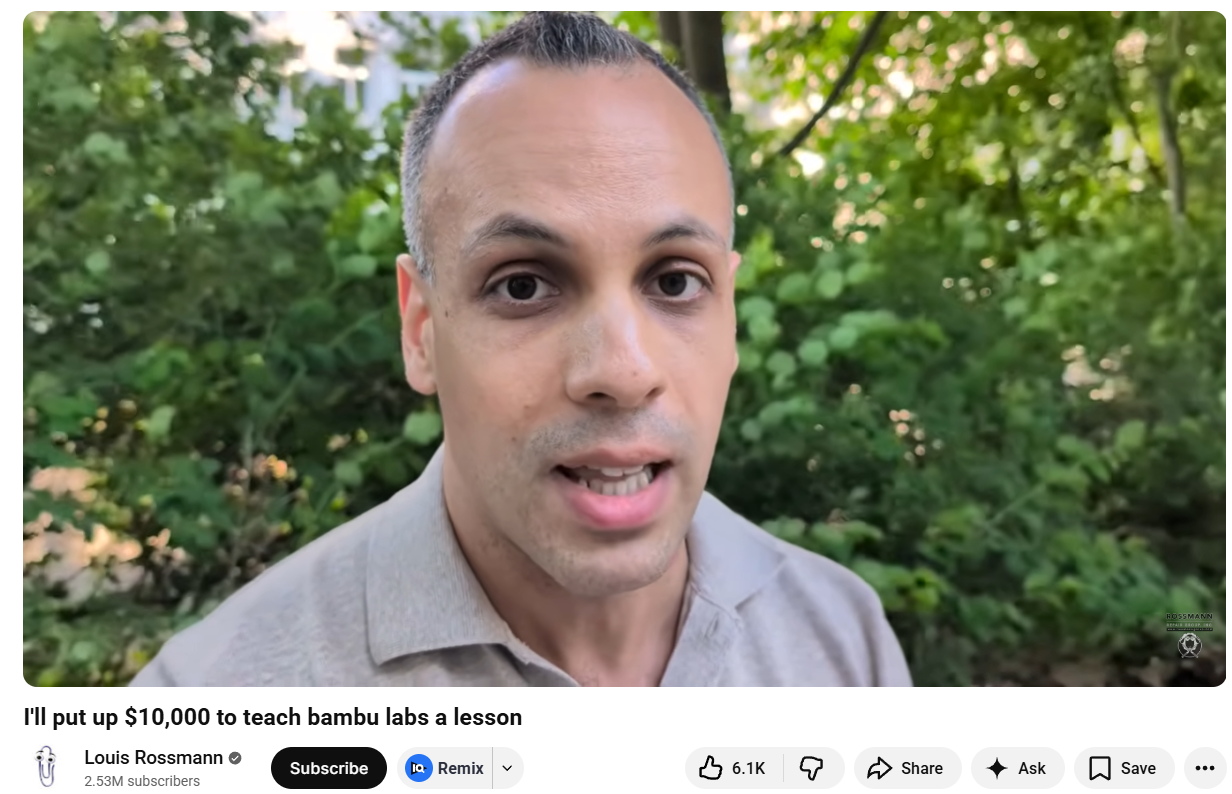
This isn’t just another skirmish in the endless war between manufacturers and tinkerers. When Louis Rossmann, a vocal champion of the Right to Repair, publicly pledged $10,000 to fight a cease and desist letter from 3D printer maker Bambu Lab, he wasn’t just backing a developer. He was drawing a line in the sand for every consumer who’s ever felt their purchased hardware slipped from their grasp the moment they brought it home.
It all centers on Pawel Jarczak, an independent software developer who dared to restore direct control between Bambu Lab’s popular 3D printers and the open-source OrcaSlicer software. Bambu Lab, citing a deluge of “unauthorized” requests—some 30 million daily—pointed the finger squarely at OrcaSlicer. Their response? A legal threat, pushing Jarczak to shut down his project, “OrcaSlicer-BambuLab.” Rossmann, seeing this as a bully move, responded with characteristic fire, not just offering financial backing but rallying his considerable Right to Repair following. “Go f*** yourself,” he declared to Bambu Lab on video, a sentiment that, while crude, resonates deeply with a community that feels increasingly locked out of their own devices.
The stakes here are higher than just a few million API calls. This is about the fundamental question of ownership. For years, the Right to Repair movement has fought against manufacturers who restrict access to diagnostics, schematics, and modification capabilities, often citing intellectual property or security concerns. Bambu Lab’s move feels like a direct affront to this principle, especially considering their own rise, allegedly built on open-source contributions they now seem intent on controlling.
Bambu Lab’s printers, often lauded for their performance and price point, have a history of being intentionally difficult to modify or repair. Early models, like the X1 Carbon, featured glued-in parts and non-replaceable components, forcing users to buy expensive replacement units rather than perform simple fixes. While later models like the H2D and X2D have improved user-friendliness, this legal action suggests a broader strategy of locking down their ecosystem.
Rossmann’s challenge is more than just a donation; it’s a call to arms. He’s asking the community to prove their support, not just with words but with potential dollars, to demonstrate to Jarczak that he’s not alone. The immediate online reaction—comments vowing to contribute without even owning a Bambu Lab printer, simply out of a hatred for perceived bullying—underscores the power of this narrative. People aren’t just buying a 3D printer; they’re buying into a philosophy of control and ownership.
It’s a classic David and Goliath setup, and Rossmann is playing the role of the enraged, well-funded protector. He’s not just offering to pay legal fees; he’s offering validation and a fighting chance. The speed at which his video gained traction and the enthusiastic comments suggest that Bambu Lab might find itself facing a much larger, more organized opposition than it anticipated. This isn’t just about OrcaSlicer anymore; it’s a test case for the broader Right to Repair movement in the burgeoning 3D printing space.
“If Bambu Labs goes after you for keeping up your code, I am so confident in your case that I will pay the first $10,000,” Rossmann said in his video. “Before Pawel makes a decision, I want him to see the overwhelming support that he has from the members of the community if he goes through with this decision.”
This whole situation is a stark reminder of how quickly innovation can outpace our legal and ethical frameworks. When a company can wield legal threats to stifle independent development that, frankly, makes their own products more useful and accessible, it signals a worrying trend. It’s a battle for the soul of product ownership, played out in the digital ether and, now, potentially in a courtroom. And thanks to Rossmann, the underdog has a fighting chance.
Why is Bambu Lab Threatening Developers?
Bambu Lab claims these third-party integrations, like Pawel Jarczak’s OrcaSlicer fork, pose a risk to their infrastructure. They reported being inundated with millions of daily “unauthorized” requests, with OrcaSlicer identified as the primary source. Essentially, they’re arguing that the unofficial software is overwhelming their servers and potentially creating security vulnerabilities.
Is This About Security or Control?
That’s the million-dollar question, isn’t it? While Bambu Lab points to server strain and security risks, many in the developer and consumer rights communities see it as an attempt to exert control over their hardware and software ecosystem. The Right to Repair movement argues that restricting modifications and independent software development ultimately harms consumers by limiting functionality and repair options. The historical context of manufacturers locking down devices makes their security claims — while potentially valid on a surface level — feel like a convenient excuse to maintain proprietary control.
What Does This Mean for 3D Printer Owners?
For owners of Bambu Lab printers, this conflict highlights the tension between convenience and control. If Bambu Lab wins, it could mean a more locked-down ecosystem, with fewer options for customization and third-party software integration. On the other hand, if developers and the Right to Repair movement succeed, it could pave the way for greater user freedom and interoperability in the 3D printing world. It’s a signal that even in hobbyist markets, the battle for true ownership is ongoing.
**
🧬 Related Insights
- Read more: Python WebSockets Expose Ad Fraud Instantly
- Read more: Claude Code: The Terminal AI That Codes Your Ideas Into Reality
Frequently Asked Questions**
What is OrcaSlicer-BambuLab? OrcaSlicer-BambuLab was a project by Pawel Jarczak that aimed to restore direct control between Bambu Lab 3D printers and the OrcaSlicer software, allowing for more customization and independent use.
What is the Right to Repair movement? The Right to Repair is a global movement advocating for consumers’ ability to fix, modify, and maintain their own products. It pushes back against manufacturers who restrict access to parts, tools, and information needed for repairs.
Will Louis Rossmann start a crowdfunding campaign? Rossmann stated he wants to first ensure there’s genuine support and willingness from the community to contribute financially before launching a formal crowdfunding site. His video aimed to gauge this interest.