The console is a blur. Lines of logs, an endless cascade of cryptic messages, and somewhere in that digital deluge, a single, catastrophic error waits to be unearthed. This isn’t just data; it’s a detective’s case file, and until now, even our most advanced AI had to be content with glancing at the evidence, making educated guesses. But what if it could actually think through the crime scene?
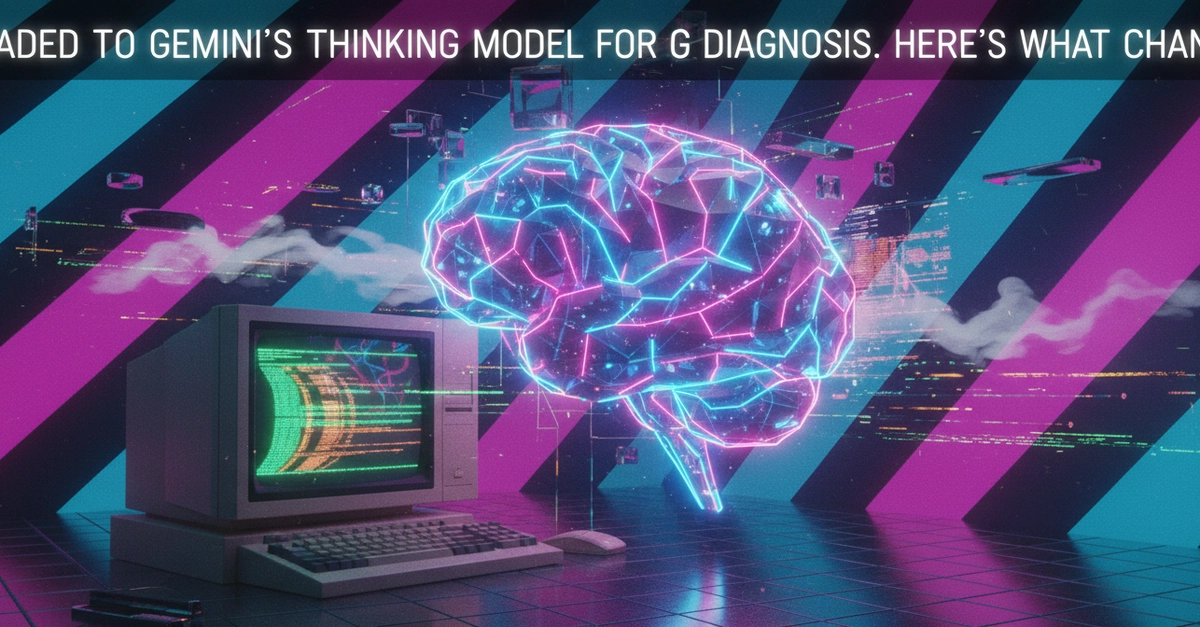
That’s the precipice we’ve arrived at with Gemini 2.5 Flash Preview. The upgrade to Google’s latest ‘thinking model’ isn’t just another iteration; it’s a fundamental platform shift for how we approach debugging complex systems. Think of it like moving from a calculator that spits out answers to a seasoned engineer who can walk you through the entire problem-solving process, step by painstaking step.
A Leap in Diagnostic Prowess
Imagine a crash report that doesn’t just say, “Looks like a NullPointerException.” Instead, it meticulously reconstructs the sequence of events. “The crash occurs because UserRepository is initialized before DatabaseHelper completes its async setup on line 847. The NPE on line 892 is a symptom — the root cause is the initialization order in MainActivity.onCreate().” This isn’t just more information; it’s actionable intelligence, pointing you directly to the architectural flaw, not just the immediate symptom.
This is the magic of a ‘thinking model.’ While a standard model might pattern-match errors, identifying known failure signatures, a thinking model actually traces the causality. It doesn’t just see the smoke; it follows the trail back to the spark, across potentially dozens of interconnected system components. It’s the difference between a librarian handing you a book on a topic and a historian walking you through the nuanced events that led to a particular outcome.
For HiyokoLogcat, an open-source tool designed for log diagnosis, this upgrade meant swapping out a single line of code:
// Before
let model = "gemini-1.5-flash";
// After
let model = "gemini-2.5-flash-preview-04-17";
That’s it. No plumbing changes, no API renegotiation. The request format, the response structure – all identical. The underlying AI, however, had undergone a profound metamorphosis.
The Trade-Off: Latency for Insight
Now, every revolution comes with a price tag. In this case, it’s latency. The original Gemini 1.5 Flash was zippy, delivering responses in around 1.5 seconds. The new Gemini 2.5 Flash Preview, with its newfound ability to ponder, stretches that time to about 4–6 seconds. For a developer tool where you’re already deep in the trenches of an error, staring at a screen, that 2.5 to 4.5-second increase in wait time is hardly a dealbreaker. It’s a modest tax for exponentially richer, more precise diagnostics.
| Model | Avg response time | Diagnosis quality |
|---|---|---|
| Gemini 1.5 Flash | ~1.5s | Good for simple crashes |
| Gemini 2.5 Flash Preview | ~4–6s | Much better for complex chains |
This performance increase is critical. When you’re debugging, the goal isn’t just to find the error; it’s to understand why it happened. This allows for more strong fixes and prevents recurrence. A generic “check your object initialization” is technically correct but often unhelpful. A diagnosis that pinpoints initialization order issues in a specific method on a particular line? That’s gold.
The Future is Thinking
What’s truly remarkable is that this ‘thinking’ capability, this quantum leap in diagnostic depth, is currently available on the free tier. This is a rarity. Preview models, especially those demonstrating such a significant performance leap, often transition to paid tiers once they hit general availability. For now, though, developers can use this advanced AI without immediate cost, though existing rate limits still apply. It’s a generous window to experiment and integrate this powerful new capability.
If you’re building any kind of developer tooling that interacts with AI, particularly for tasks involving code analysis, error reporting, or log interpretation, take note. Don’t just default to the latest stable release; actively evaluate the preview ‘thinking’ models. The difference in output quality for causality-driven tasks is immense. It feels less like a tool and more like an assistant who truly grasps the nuances of your problem.
This upgrade to Gemini 2.5 Flash Preview isn’t just about a faster or smarter model. It signifies a new era where AI doesn’t just process information; it reasonsthrough it. This is the fundamental platform shift we’ve been waiting for, transforming complex diagnostic challenges from tedious searches into insightful explorations. It’s time to embrace the thinking AI.
Will this new Gemini model make my job obsolete?
Not in the foreseeable future. While AI can now perform complex diagnostic tasks with remarkable accuracy, it acts as an enhancer, not a replacer. Developers will still be needed to architect systems, understand context, and interpret AI-generated insights. The AI handles the heavy lifting of data analysis, freeing up developers for higher-level problem-solving.
How is Gemini 2.5 Flash Preview different from other AI models?
The key differentiator is its ‘thinking’ capability. Unlike models that primarily pattern-match or generate text based on statistical correlations, Gemini 2.5 Flash Preview is designed to trace causal relationships within data, enabling deeper, more actionable insights for complex problems like log diagnosis.
Is Gemini 2.5 Flash Preview generally available now?
At the time of writing, Gemini 2.5 Flash Preview is available as a preview model. It’s accessible on the free tier with existing rate limits. However, preview models typically move to paid tiers or general availability with updated pricing structures.