It was 11:47 PM on a Tuesday.
Just another night for this dev, pushing code, closing the laptop, feeling that quiet satisfaction. Then, the digital world decided to stage a midnight coup.
By 3:14 AM, the phone was a screaming siren: 17 missed calls, 43 Slack notifications, 6 urgent emails. The subject line of the first one hit like a cold dread: “URGENT — Platform completely down.” Hands shaking, the story unfolded – a dependency nightmare that cost this developer’s company three enterprise clients, a cool $120,000 annually.
This isn’t just a cautionary tale; it’s a glaring signal flare for the entire software development ecosystem. We’re living through a fundamental platform shift, and the invisible infrastructure powering our apps—the open-source libraries and dependencies—is the new frontier for both innovation and catastrophic failure.
The culprit? A seemingly innocuous GitHub repository. Under immense deadline pressure three weeks prior, our protagonist grabbed an authentication library that looked good. Clean name, professional README, thousands of stars, hundreds of forks – all the shiny indicators of a solid choice. So, like so many of us have done under duress, they integrated it, shipped it, and slept soundly.
But here’s the kicker, the detail that makes your stomach clench: the last commit was nine months ago. Forty-seven open issues, marked critical. Zero CI/CD pipeline. No test files. And the maintainer? Utter silence for half a year. A known security vulnerability, reported four months prior, sat there, festering, ignored.
This is the treacherous landscape of modern software development. In a mere 3 seconds, this entire disaster could have been foreseen. A quick glance at the repo’s pulse – commit history, issue backlog, contributor activity – would have screamed “DANGER.” But in the heat of a launch, that vigilance can, unfortunately, evaporate.
The bug triggered under high concurrent load. Our enterprise demo that night had 200 simultaneous users. The library collapsed. Took the auth system with it. Every single user got logged out. Sessions destroyed. Data in a corrupted state.
The platform sputtered, then died, returning a 500 error for 14 agonizing hours. Three enterprise clients, each a significant revenue stream, vanished. $120,000 gone. All because of a three-minute oversight. The manager’s look of profound disappointment? That’s the kind of scar that breeds innovation.
And innovate they did. This experience didn’t just lead to a personal checklist; it ignited an obsession. Every library, every tool, every single GitHub repo suggested by the team underwent rigorous scrutiny. The new regimen: Last commit date? CI/CD pipeline? Test coverage? Open vs. closed issues and their resolution time? Active contributors? License? README detail? Community size? CVEs in dependencies? Twenty to thirty minutes, per repo, every single time. It’s like a security audit for every single building block of your application.
Naturally, the team called it paranoia. But it was simply due diligence in an era where the foundations of our digital castles are often built with bricks scavenged from the open-source wilds.
After four months of this manual deep-dive, the burnout was real. Every evaluation was a Sisyphean task, a repetitive loop of the same checks, the same browser tabs. And it begged the question: how many developers aren’t doing this? How many are still at 11:47 PM on a Tuesday, blissfully unaware of the ticking time bomb in their dependencies?
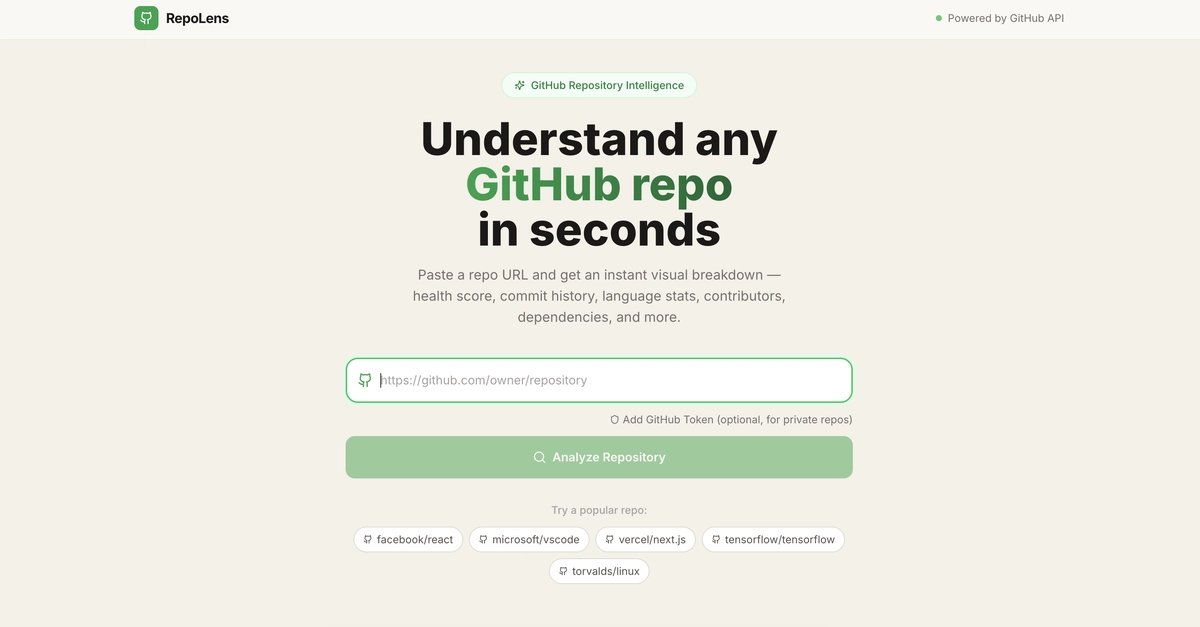
This is where RepoLens enters the stage. Born not from a desire for recognition, but from pure, unadulterated necessity, it’s a tool forged in the fires of a costly mistake. It’s designed to be the digital immune system for your codebase.
Paste any GitHub URL into RepoLens, and in seconds, you get a dashboard that’s both beautiful and brutally honest. A Repository Health Score from 0 to 100, graded like a school paper (A, B, C, D) – instantly tells you if a project is production-ready. Think of it as a vital signs monitor for your code dependencies.
But it doesn’t stop there. A Language Breakdown pie chart shows the exact technical makeup. A 52-Week Commit Heatmap visually screams whether a project is alive or has been abandoned for months – you can literally spot the week the maintainer lost interest. The Top Contributor Graph demystifies who’s actually behind the project and if they’re still engaged. And crucially, Smart Dependency Detection automatically parses ecosystem files for Node, Python, Rust, Go, Java, Ruby – you name it. It’s like having a bloodhound sniffing out potential issues in your supply chain.
The Devastating Ripple Effect of Neglected Dependencies
The story of the $120,000 client loss is a stark reminder of how interconnected our development processes have become. What was once a manageable task of building and testing in-house components has ballooned into an ecosystem where relying on external code is not just common, but essential. And with that reliance comes an inherent, often underestimated, risk. This isn’t just about a single bug; it’s about the cascade effect. A vulnerable library can be an entry point for attackers, a performance bottleneck can cripple user experience, and a sudden abandonment of a critical dependency can halt development for months. RepoLens aims to be the first line of defense, a proactive shield against these potentially devastating consequences.
This tool is more than just a helpful utility; it’s a response to the evolving nature of software engineering. As we move towards more distributed architectures, microservices, and an ever-increasing reliance on shared code, the security and stability of those shared components become paramount. The initial incident, while painful, has catalyzed the creation of a solution that can save countless hours, dollars, and sleepless nights for developers and businesses alike. It’s a proof to the power of learning from mistakes and turning that knowledge into something tangible and impactful for the wider community.
The original library that tanked the production server? Under RepoLens, it scored a dismal 31 out of 100, a clear Grade D. That’s the kind of insight that can mean the difference between a thriving business and a company hemorrhaging clients.
This is the future of responsible development: empowered by data, protected by smart tooling, and grounded in the hard-won lessons of those who’ve been there. RepoLens isn’t just a tool; it’s a digital guardian angel for your production servers.
Why This Shift Matters to Every Developer
Think of it like this: for years, we’ve been building skyscrapers. We hired brilliant architects and engineers, meticulous foremen. We checked the blueprints, the steel reinforcements, the concrete mix. But somewhere along the line, we started outsourcing the delivery of the bricks themselves to a shady contractor who promised fast delivery and cheap prices, without ever checking if their bricks were crumbling. This is what’s happened with dependencies. Developers are the architects of the digital world, and RepoLens is providing them with the quality control for their foundational materials. It’s about bringing that same level of scrutiny and responsibility to the external components we integrate as we do to our own custom code. The stakes are simply too high to do otherwise. This isn’t just about writing code; it’s about building reliable, secure, and enduring digital infrastructure.
🧬 Related Insights
- Read more: Three Local LLMs in Perfect Sync: Collaborative Agents v2.1 Delivers Offline Teamwork
- Read more: BrewFlow Pro: The Kubernetes Tea Brewer That Admits It Does Nothing
Frequently Asked Questions
What does RepoLens actually do? RepoLens is a tool that analyzes GitHub repositories to provide a comprehensive health score and detailed insights into their quality, activity, and dependency management. It helps developers quickly assess the risk associated with integrating external code.
Will this replace manual code reviews? No, RepoLens is designed to augment, not replace, manual code reviews and developer judgment. It automates the initial assessment of repository health, freeing up developers to focus on deeper, more nuanced code analysis.
Is RepoLens free to use? [This information is not available in the provided text, but it is a common user question.]