Only 4% of CKA exam candidates pass on their first try, according to some forums. That number, while anecdotal, hints at the exam’s notorious difficulty. And here’s the punchline: Kubernetes documentation is permitted. Seems like a godsend, right? Wrong. It’s a trap. The exam doesn’t reward you for having the documentation; it punishes you for not being able to find what you need with blinding speed.
Forget memorizing every single YAML field or kubectl flag. Nobody does that in the real world. What separates the competent from the utterly lost is knowing where to look and how to ask the right questions. The CKA exam mirrors this reality. It’s less a test of recall and more a test of your ability to be a functional, pressure-cooker administrator.
My Biggest Mistake: Treating It Like School
Early on, I fell into the classic trap: trying to memorize everything. Network Policies, RBAC, Persistent Volumes — I hammered them into my brain. It was a colossal waste of time. The shift came when I stopped trying to be a walking Kubernetes encyclopedia and started focusing on understanding concepts, mastering kubectl, and, most importantly, learning the labyrinthine layout of the official Kubernetes documentation.
Think Like a Pro, Not a Student
Real-world Kubernetes admins don’t have perfect recall. They’re not ashamed to consult the docs, verify configurations, or crib examples. The CKA exam is a simulation of that professional environment. My objective wasn’t encyclopedic knowledge; it was the speed and accuracy of finding information when seconds counted.
The Sacred Scrolls: Docs I Actually Used
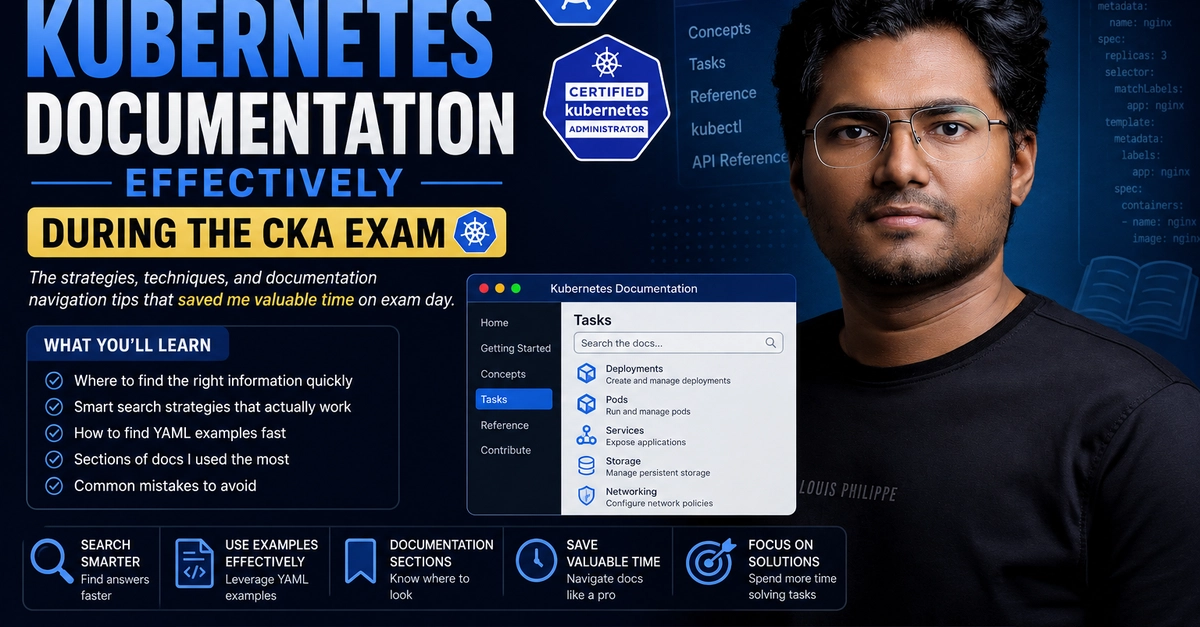
During my prep, certain sections became my digital gospel:
Tasks Section: This was gold. Step-by-step guides for creating Deployments, ConfigMaps, Secrets, and the dreaded Network Policies. It’s the closest you’ll get to a cheat sheet.
kubectl Reference: Forgot the exact syntax for kubectl expose or kubectl drain? This was my go-to. It’s packed with command options and examples.
Concepts Section: When things got fuzzy on networking, storage, or scheduling, I dove into Concepts. Understanding the ‘why’ is often more critical than recalling a specific command.
API Resource Examples: Sometimes, the fastest path was finding a working YAML example and tweaking it. Why build from scratch when a functional template exists?
The Navigation Hack: Practice Like You’re on the Clock
My secret weapon? I practiced using the documentation during my lab sessions. Every time I spun up a cluster or deployed an app, I forced myself to find the relevant info in the docs. This built muscle memory for the search and navigation. By exam day, I knew where to go without thinking.
Search Smarter, Not Harder: Keyword Kung Fu
Here’s where most people bleed precious minutes. Searching for storage is useless. Searching for persistent volume claim example is smart. Instead of a broad rbac, try rolebinding example. Specificity is your friend. It’s the difference between a quick answer and a slow descent into panic.
Documentation can help you remember syntax. It cannot replace hands-on experience.
That quote hits the nail on the head. The docs are an accelerator, not a substitute. If you don’t grasp the fundamentals of Pods, Deployments, or Services, the documentation will stare back at you, mocking your lack of understanding.
My Favorite Time-Saver: The Dry Run Gambit
YAML generation is a pain. So, I combined kubectl create --dry-run=client -o yaml with the documentation. Generate a basic structure, then consult the docs to fill in the specifics. It’s efficient.
Common Documentation Fumbles
1. Over-reliance: If you need the docs for basic Pod creation, you’re not ready. Docs should augment, not replace.
2. Reading the Novel: No time for prose during the exam. Focus on examples, syntax blocks, and configuration snippets.
3. Avoiding Docs in Prep: This is madness. Practicing without docs is like training for a marathon without ever running a mile.
Is This the Future of Kubernetes Certification?
Allowing documentation is a sensible nod to reality. But the CKA exam’s true test is efficiency. It forces you to internalize not just Kubernetes itself, but the process of administering it under duress. It’s a subtle but vital distinction. The exam isn’t about being a memorization champion; it’s about being a quick-thinking, resourceful administrator.
Why Does This Matter for Developers?
Even if you’re not aiming for CKA, this philosophy applies. In the sprawling world of cloud-native tech, quick access to accurate information is paramount. Developers who can efficiently find and adapt documentation will always outperform those who rely solely on memory or guesswork. It’s about speed, accuracy, and reducing cognitive load.
🧬 Related Insights
- Read more: WeiQi: Go’s Ancient Strategy Meets Modern Productivity
- Read more: Beyond English & Spanish: America’s Lingual Mosaic Revealed
Frequently Asked Questions
What does the CKA exam actually test?
It primarily tests your ability to apply Kubernetes administration knowledge efficiently under timed conditions, including effective use of documentation.
Can I pass the CKA by just reading the documentation?
No. While documentation is allowed and useful, you need hands-on practice and conceptual understanding to pass.
How much time can documentation save in the CKA exam?
Significant time. Being able to find answers quickly, rather than slowly searching or trying to recall, can be the difference between passing and failing.