The soft glow of a monitor illuminating a face hunched in concentration—that’s the picture of deep work. But what happens when that work is done inside a chat interface, a place designed for fleeting conversation, not enduring knowledge?
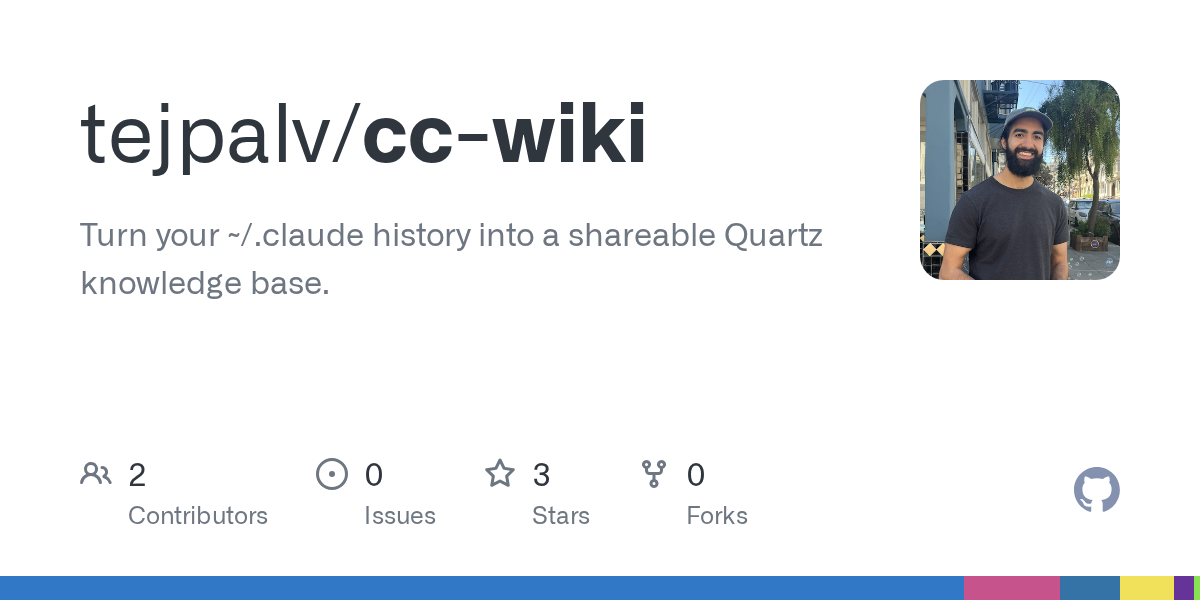
CC-Wiki. That’s the name. It’s a command-line tool, a script really, that aims to pull your Claude Code sessions, your hours of back-and-forth with an AI, and stitch them into something… permanent. Something you can actually share. Something that resembles an arXiv paper, apparently. Because apparently, the only way to validate AI-assisted research is to make it look like traditional academia. Right.
Look, we’ve all been there. You’re deep in the weeds with an LLM, hashing out a complex problem, and suddenly, you’ve got a goldmine of insights. Solutions. Explanations. Code snippets that actually work. And then what? You close the tab, and poof. Gone. Or maybe you copy-paste it all into a sprawling document that you’ll never, ever look at again. The folks behind CC-Wiki, who’ve apparently been doing some serious deep dives for both personal and work projects, clearly felt this pain. Their solution? A skill that hooks into Quartz, a static site generator. The pitch: turn your local .claude session history into a “rigorous arXiv-like knowledge base.” Fancy.
Why an arXiv-like knowledge base? Because nothing says “cutting-edge development” like mimicking the dusty halls of theoretical physics. It’s a clever framing, I’ll grant them that. It implies structure, authority, and reusability. But let’s peel back the jargon for a second. What is this thing, really? It’s a script that processes your conversation logs, presumably looking for patterns, structured output, and maybe even sentiment (though they don’t explicitly say that part), and then feeds it into Quartz to spit out a website. A website that acts like a personal wiki for your AI interactions.
Is This Actually Useful, or Just Another AI Wrapper?
Here’s the million-dollar question, or rather, the zero-dollar question since this appears to be MIT licensed and free. Does CC-Wiki actually solve a problem, or does it just create a slightly more organized way to archive AI-generated text? The initial install is a one-liner you pipe through bash. Standard stuff for any self-respecting CLI tool these days. Once installed, you just type /cc-wiki in your Claude Code session. Simple enough. The real magic, they claim, is in transforming those raw conversations into something useful for sharing and future reference. Think of it as taking your brainstorming whiteboard doodles and turning them into a professionally printed booklet.
The core of the tool relies on processing local Claude session files, which are typically stored as text. The output then use Quartz, a project from Jacky Zhao, to generate the static site. This means the output is likely highly customizable and definitely portable. No proprietary cloud storage here, which is a definite plus in my book. This is where my skepticism kicks in, though. How “rigorous” can a knowledge base be if it’s derived from a series of potentially rambling, context-switching AI chats? The quality of the output is entirely dependent on the quality and structure of the input – both from the user and the AI.
CC-Wiki is a skill + Quartz-based template that looks at local .claude sessions and builds a rigorous arXiv-like knowledge base, so no context goes to waste.
“No context goes to waste.” That’s a bold claim. LLMs are notorious for their capacity to hallucinate or go off-topic. Will CC-Wiki intelligently filter out the noise, or will it dutifully archive every single tangent? The promise of a “knowledge base” suggests some level of curation or organization. If it’s just a verbatim dump, then the “arXiv-like” descriptor feels more like marketing fluff than a technical reality. I’ve seen too many AI tools promise organization and deliver digital clutter.
What’s interesting is the timing. As LLMs become more sophisticated, and we rely on them for increasingly complex tasks, the need to manage and contextualize the information they provide becomes paramount. This isn’t just about saving code snippets; it’s about building a searchable, navigable repository of AI-driven problem-solving. If CC-Wiki can achieve this, even in a basic form, it could be a genuine productivity booster for anyone deeply embedded in LLM-assisted workflows. The fact that it’s built on standard Python (stdlib only, nice touch) and Node.js for Quartz means it’s not some obscure, proprietary black box. That’s always a good sign. But who is actually making money here beyond the satisfaction of building a useful tool? It seems like a passion project released into the wild, which is fine, but it also means user expectations should be managed. No SLAs, remember?
Who’s This For, and What’s the Catch?
This is clearly aimed at developers and researchers who are heavy users of AI coding assistants like Claude. If you’re casually using an LLM for a quick question here and there, this is probably overkill. But if you’re doing sustained, complex problem-solving, where sessions can stretch for hours and cover multiple angles of a topic, then the idea of packaging that up becomes attractive. The requirement for macOS or Linux, Python 3.9+, and Node 22+ isn’t exactly a barrier to entry for the target audience, but it’s worth noting for anyone on Windows looking to dabble.
The real question for me is the quality of the generated knowledge base. Does it intelligently extract key findings, summarize complex arguments, or simply present a chronological log of the chat? The “rigorous arXiv-like” phrasing implies the former, but the underlying mechanism (processing text logs) suggests the latter could easily be the outcome. The effectiveness hinges on how well it can discern signal from noise in AI conversations. Without more detailed documentation on the processing logic, it’s hard to say. But as a starting point for turning ephemeral AI interactions into something more tangible, it’s a step in the right direction. Whether it’s a giant leap forward or just a small shuffle remains to be seen, but at least it’s an attempt to solve a real problem in the burgeoning field of AI-assisted development.
🧬 Related Insights
- Read more: Selenium’s Enduring Reign in Web Automation
- Read more: ccheckpoints: Git for Your Claude Code CLI Sessions — No More Lost AI Magic
Frequently Asked Questions
What is CC-Wiki?
CC-Wiki is a tool that converts your Claude Code AI chat sessions into a shareable, website-based knowledge base, structured like an arXiv paper. It helps preserve and organize insights gained during AI interactions.
Is CC-Wiki free to use?
Yes, CC-Wiki is released under the MIT license, indicating it’s free to use and modify. The developers note there is no Service Level Agreement (SLA).
What are the system requirements for CC-Wiki?
CC-Wiki requires macOS or Linux, Python 3.9+ (standard library only), and Node 22+ (for Quartz website generation). Claude Code is also a prerequisite.